

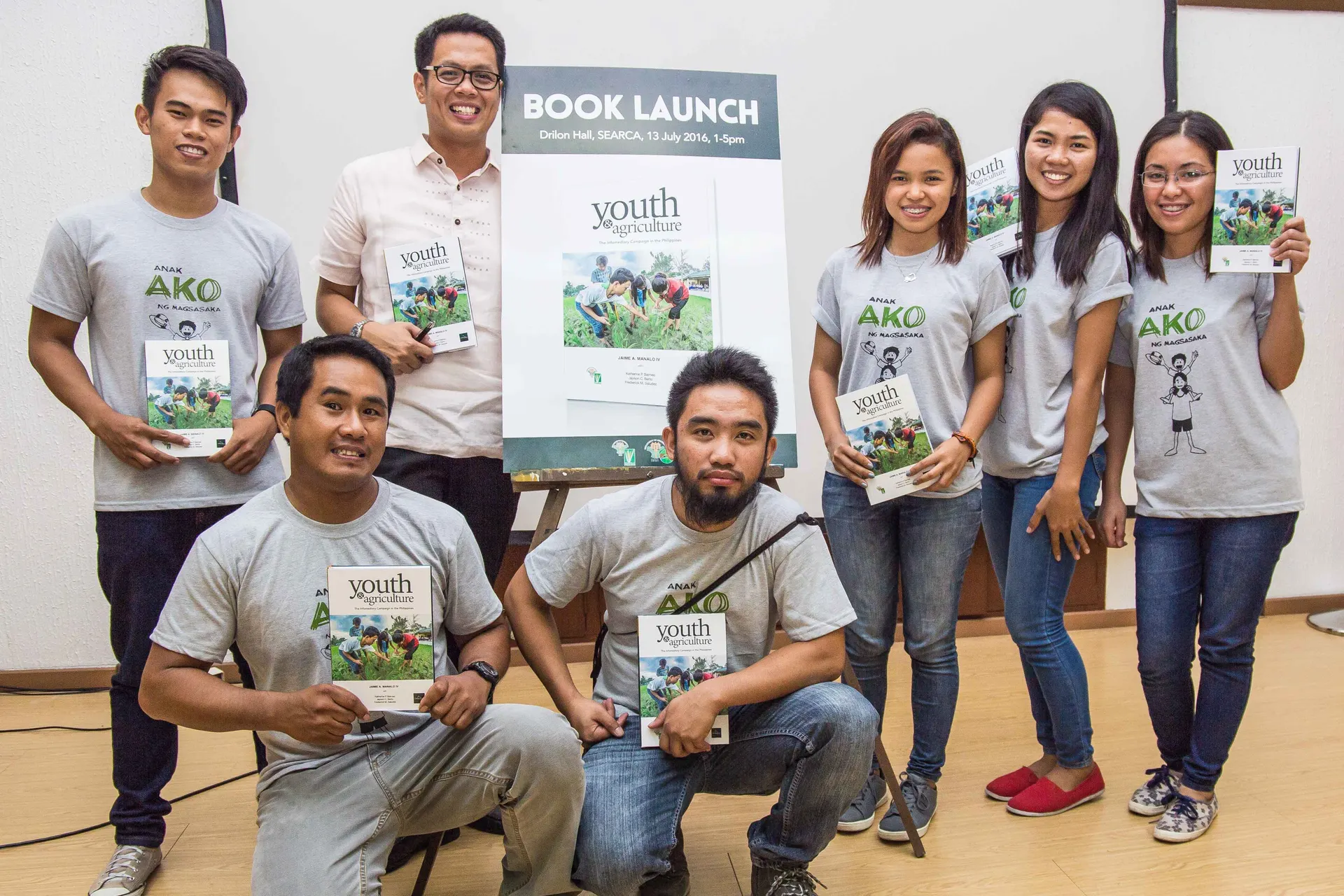
In a matter of 3-4 hrs, the new book Youth & Agriculture: The Infomediary Campaign in the Philippines can help readers realize that young people, when empowered, can help create impacts in rural rice-farming communities alive.
This book aims to guide and provide wisdom to development workers particularly the extension practitioners, students and professionals in involving the youth in agriculture, and raise curiosity among scholars to contribute significantly in improving current efforts in the field.
This is a product of more than three years of the Infomediary Campaign, an action research to engage young people as information providers in their respective rice-farming communities. It is an initiative of the Philippine Rice Research Institute (PhilRice) in collaboration with the Technical-Vocational Unit of the Bureau of Secondary Schools of the Department of Education (DepEd) and the CGIAR Research Program on Climate Change, Agriculture and Food Security (CGIAR-CCAFS).
Campaign team lead Jaime A. Manalo IV is the main author, with contributions from team members Katherine P. Balmeo, Jayson C. Berto, and Fredierick M. Saludez.
Going through the pages can offer a lot to a variety of readers.
Notably, the book is a strategic move to present and promote the campaign. Infomediary was introduced, including the issues that it seeks to address, and the major components and key activities.
It does not only speak to the stakeholders of the Infomediary Campaign. Anyone related to agriculture, rural farming communities, communication, and agencies can find the content enthralling because of the stories related to the campaign’s implementation. Also, both new and veteran field workers may find valuable insights in community field works that were disclosed in several chapters.
Further, accounts of what-went-well and what-went-wrong were documented. The best-fit practices from the implementers, schools, and other stakeholders were highlighted while glitches during campaign implementation were noted.
The contents were written on a serious note, yet there were excerpts that were light and entertaining. For instance, there were sections tackling useful research methodologies, implementation strategies, including field work tips that add up to the reader’s knowledge. On one hand, there were stories written in first person point of view, which can keep readers smiling and nodding at the stories they can relate with.
Meanhwile, discussions were aggressive. Dominant views and global statistics worked in two ways. These were used to corroborate the campaign’s results. Conversely, these were confronted to examine its certainty, which make readers contemplate.
Aside from good reads, the book is also full of interesting visual footages that complement written messages. The photos keep the stories alive in the reader’s mind and reflective of the campaign’s initiatives, while graphics are informative and entertaining.
All told, the book Youth & Agriculture: The Infomediary Campaign in the Philippines is more than a research journal. The book is a gift of knowledge that does not only tell readers about the campaign, but also inspires and helps people realize that with the youth, there is hope in agriculture.
Written by Anna Marie F. Bautista, development communicator at the Philippine Rice Research Institute.
See more at: http://www.philrice.gov.ph/keeping-rural-rice-farming-communities-alive-youth-agri-book/#sthash.Lt3LHQY6.dpuf